

Key Takeaways
-
Begin with the property’s location, wind exposure, and local code requirements before choosing a style.
-
Impact resistance, design pressure, and water resistance are different performance measures that may all matter.
-
The complete assembly matters, including the door, frame, glass, threshold, hardware, fasteners, and installation details.
-
Coastal materials and finishes should be selected for salt air, humidity, intense sun, and frequent rain.
-
Save approval documents, product labels, and installation instructions for permitting, inspections, and future maintenance.
A coastal entry door has to do more than create an attractive first impression. It may need to handle powerful winds, wind-driven rain, airborne debris, salt-heavy air, humidity, and daily traffic. When comparing hurricane impact doors, focus on how the entire assembly performs at your specific address, not simply on the appearance of the slab or glass.
In a coastal setting, an entry door is part of the home’s protective envelope. A highly rated door can still underperform if its frame, threshold, hinges, weatherstripping, or wall connection is not designed and installed correctly. The best choice balances code compliance, reliable operation, water control, energy performance, and a style that suits the home.
Start With The Site, Not The Style
Requirements can vary considerably between communities, even within the same coastal state. Local wind speed, building height, exposure to open water or open terrain, door size, and the opening’s location on the structure can all affect the required performance level. A sheltered courtyard door may face different conditions than a front door aimed toward the ocean or a broad, unobstructed yard.
Before ordering, ask whether the home is in a hurricane-prone area or wind-borne debris region, whether impact protection is required, and whether the project is subject to special high-wind rules. Also confirm homeowners’ association, historic district, or neighborhood design restrictions. Your contractor, designer, engineer, or building department should confirm the exact criteria for the permitted project.
Know The Ratings That Matter
Technical labels can be confusing, but a few terms make it easier to compare options. Design pressure refers to the wind load that a tested door system can resist. Impact rating addresses resistance to debris strikes. Water infiltration performance indicates how the assembly handles rain driven toward the opening under pressure. These are related, but one rating does not automatically prove performance in every other category.
Product documentation should match the exact configuration you plan to install. That means checking the size, swing direction, glass type, frame, sill, hardware, and any sidelites or transom. The wind-pressure guidance for exterior door assemblies also emphasizes that doors must be securely fastened so that loads transfer to the adjacent wall, rather than merely being resisted by the slab.
Compare Impact Protection, Wind Resistance, And Water Control
Think of these features as separate layers of protection:
-
Impact protection: Helps a glazed opening remain protected after debris strikes during severe storms.
-
Design pressure resistance: Helps the door, frame, glass, and hardware withstand repeated positive and negative wind loads.
-
Water resistance: Helps limit rain intrusion at the glass, frame joints, sill, threshold, and wall connection.
A door can be impact-rated yet still require a specific design pressure rating for the building. Likewise, a door that resists wind loads may not provide the level of water management needed for an exposed coastal entry. Ask for documentation that applies to the complete unit, not just an individual component.
Choose Materials For Salt, Sun, And Moisture
Coastal exposure is demanding over the long term. Salt can speed corrosion, ultraviolet light can fade finishes, and moisture can damage unprotected wood or vulnerable sill components. Look for durable frame materials, sealed edges, corrosion-resistant hardware, and finishes intended for humid or salt-air environments.
Material Checks Before You Buy
-
Confirm that exposed wood surfaces are sealed on all sides and edges.
-
Ask whether hinges, locks, screws, and strike plates are appropriate for coastal exposure.
-
Inspect how the threshold and sill direct water away from the interior.
-
Check whether weatherstripping, sweeps, hinges, and lock parts can be replaced later.
-
Choose a finish and color that can tolerate the amount of direct sun at the opening.
Match The Door Style To The Opening
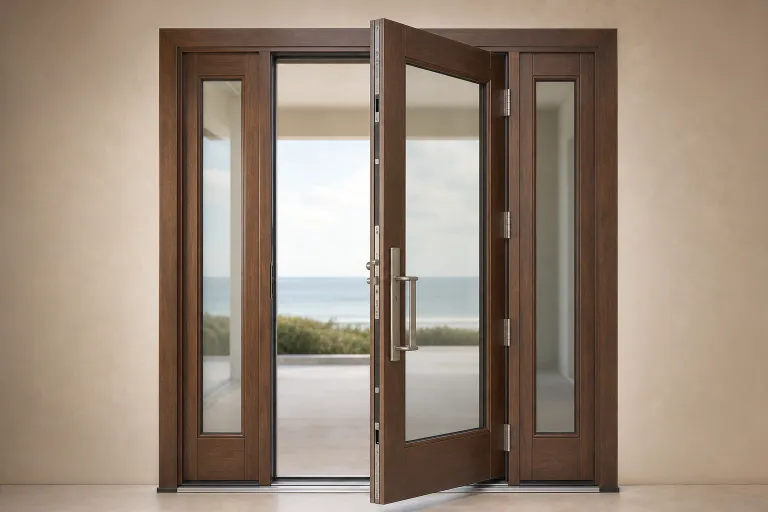
Single-entry doors work well for compact openings and straightforward layouts. Double doors create a wider passage and a more formal look, but they require careful alignment and dependable inactive-panel hardware. French doors can add light and symmetry, while sidelites and transoms can make an entry feel larger. However, every added glazed section becomes part of the rated opening and should be reviewed with the main door.
Evaluate Glass, Hardware, And Locks Together
Glass affects privacy, daylight, heat gain, insulation, maintenance, and storm performance. Ask whether the glazing is decorative, insulated, laminated, or impact-rated, and request the thermal information for the full unit. Larger glass areas can be beautiful, but they may also change the required approval and the amount of solar heat entering the home.
Do not treat hardware as an afterthought. Hinges must support the door’s weight, fasteners must suit the frame and wall system, and the lock should engage consistently. Multipoint locking can improve alignment and security for some configurations. Most importantly, the door should latch easily and open from the interior when needed.
Plan For Water Management And Installation
Wind-driven rain finds small gaps. Effective installations use a properly prepared rough opening, flashing, a sill pan where required, compatible sealants, drainage paths, weatherstripping, and a correctly adjusted threshold. Proper rough-opening flashing and air sealing help reduce uncontrolled air leakage around the frame while supporting the wall’s water-management strategy.
Installation can make or break a door’s performance. Measure the rough opening at several locations, confirm that it is square and structurally sound, follow the approved fastening pattern, and test the swing, latch, seals, and locking points before the trim is installed. Keep the product label, approval number, instructions, and inspection paperwork in the home’s records.
Balance Storm Performance With Everyday Comfort
A strong coastal door should also support year-round comfort. Compare insulation, air leakage, glass performance, weather seals, and solar heat gain, as well as wind and impact ratings. A door that looks impressive during a storm but allows hot, humid air into the home every day may be a poor long-term value.
Common Mistakes To Avoid
-
Choosing based only on appearance or price.
-
Assuming every impact-rated product meets every jurisdiction’s requirements.
-
Reviewing the door slab but overlooking the frame, glass, threshold, or sidelites.
-
Using hardware that is not suited to salt air and humidity.
-
Skipping flashing, sill-pan, drainage, or sealing details.
-
Hiring an installer without experience in high-wind construction.
-
Waiting until late in the project to obtain approval documents.
A Simple Buying Process
First, confirm the site conditions and code requirements. Next, establish the needed design pressure, impact protection, and water resistance. Then choose the opening layout, materials, glass, finish, and hardware. Request documentation of the exact configuration, coordinate installation details before delivery, and establish a maintenance routine to clean salt deposits, lubricate moving parts, check seals, and promptly repair finish damage.
Conclusion
The right coastal entry door begins with the building site and ends with careful installation. Style remains important, but it should follow performance requirements rather than replace them. By evaluating local code, tested ratings, water management, materials, glass, hardware, and installation as a single system, homeowners can select an entry door designed for both daily use and demanding coastal weather.
