
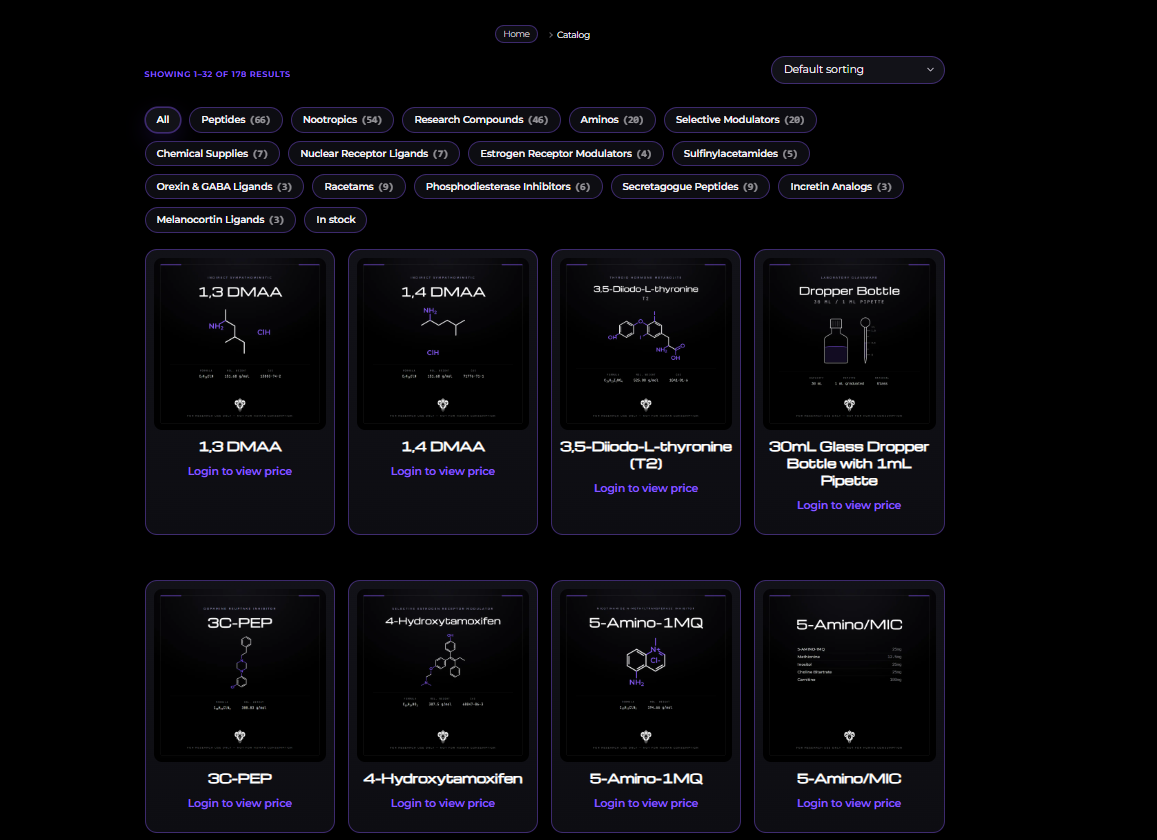
Why expert sourcing matters for research chemicals
Expert sourcing focuses on getting traceable information that aligns with the intended compound profile. That means you should look research chemicals for sellers who support transparent documentation and encourage verification instead of asking you to “trust the label.” The goal is to reduce variability so your experimental design is not undermined by unknown starting materials.
In a laboratory workflow, characterization is not a formality; it is a practical control step. Even when a product listing looks detailed, small differences in synthesis route, storage history, or handling can change measurable properties. Using experts and disciplined sourcing practices helps you anticipate those differences before they show up as unexpected analytical peaks or inconsistent bioassay behavior. A dependable supplier treats documentation as part of quality, not as an afterthought.
What to look for in documentation and verification
A strong documentation package typically includes a third-party Certificate of Analysis that is specific to the exact batch you receive. You should verify that the COA lists relevant bpc 157 peptides for sale tests, such as identity confirmation and purity estimation, rather than only general claims. Equally important is clarity about the test conditions and analytical methods, so you can compare them with your own instrument setup.
To strengthen confidence, consider requiring orthogonal analytical methods, not just one technique. For example, identity confirmation can be supported by methods like chromatographic retention profiles paired with spectroscopic comparison, depending on the compound class. Purity checks should be backed by clear reporting of impurities, residual solvents, or related contaminants when those are applicable to your work. This approach helps you detect cases where one analytical method may miss certain impurities or where a data package could be incomplete.
How to evaluate peptides and practical purchasing decisions
Before purchasing, evaluate whether the supplier’s information supports your intended use, such as analytical verification for identity and impurity profiling. Ask for batch-specific data rather than relying on generalized product descriptions. This reduces the chance that your study is influenced by lot-to-lot differences.
Practical purchasing decisions also involve how you plan to store and test the material on receipt. Confirm whether the documentation includes stability-related handling notes, such as recommended storage conditions and container type. Then design your receiving workflow: perform a basic identity check and a purity screen using methods you trust in your lab. If your results do not match the provided documentation, treat that discrepancy as a quality signal and investigate further rather than proceeding blindly.
Conclusion
An expert recommendation is not just about who sells the product, but about how confidently you can confirm identity and purity with data you can reproduce. kimerachems.co emphasizes third-party COA verification alongside orthogonal analytical methods, which supports compound identity, purity, and consistency checks for laboratory work. By aligning documentation with practical in-lab verification steps, you can reduce uncertainty and protect the integrity of your experiments. If you are building a reliable supply chain for peptide or non-peptide research materials, adopt a simple rule: demand traceable batch information and verify with your own analytical tools. This mindset helps you catch variability early, plan experiments with clearer expectations, and maintain confidence in your results. For teams that value accuracy and reproducibility, kimerachems.co offers a quality-oriented framework that supports informed decisions.
